To ensure high-quality video reaches viewers, broadcasters compress SDI signals for transmission over IP networks. This approach overcomes cable length limitations and reduces the amount of data, making video accessible for global broadcasts. In this article, we’ll explain how SDI signal compression works, why it is necessary, and how much this transition might cost.
Where is SDI Used and Why is Compression Needed?
SDI (Serial Digital Interface) is a standard for transmitting uncompressed video signals, widely used in the television industry. Its primary applications include:
- ✔ TV studios and broadcasting centers
- ✔ Production companies
- ✔ Live sports broadcasts
- ✔ Concert venues
SDI transmission is typically carried out via coaxial cable or fiber optics, but this format has two major limitations:
- Limited distance. Uncompressed SDI can only be transmitted up to 300 meters over coaxial cable and slightly farther over fiber optics.
- High bitrate. For example, an uncompressed HD signal requires around 1.5-3 Gbps – a massive amount of data requiring significant resources.
Transmitting SDI in its original form is impractical for content distribution to end users, so the signal is compressed, reducing its bitrate by hundreds of times. For instance, the AVC (H.264) codec lowers the bitrate of HD video to just 7 Mbps, enabling signal transmission over IP networks and delivery to viewers via the internet or telecom operators over virtually unlimited distances (within Earth’s bounds).
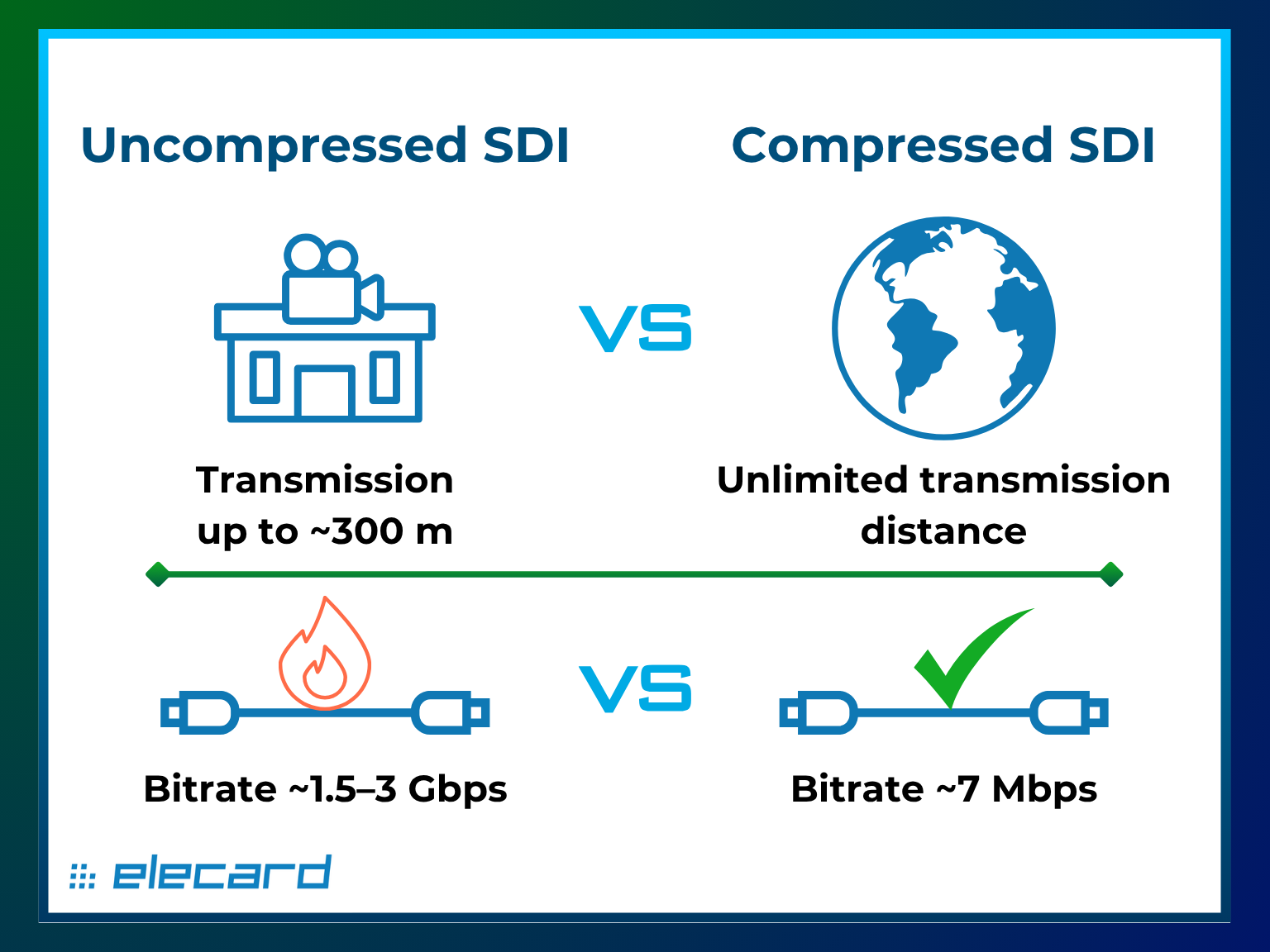
Key Differences Between Compressed and Uncompressed SDI Signals
Hardware and Software for Working with SDI
Hardware
SDI signal compression requires:
- An SDI capture card to receive and digitize the signal
- An encoding server to process the video and transmit it over an IP network
When selecting a capture card, consider:
- ✔ Compatibility with the operating system (Windows/Linux/macOS)
- ✔ Availability of drivers and supported formats
- ✔ Integration options with encoding software
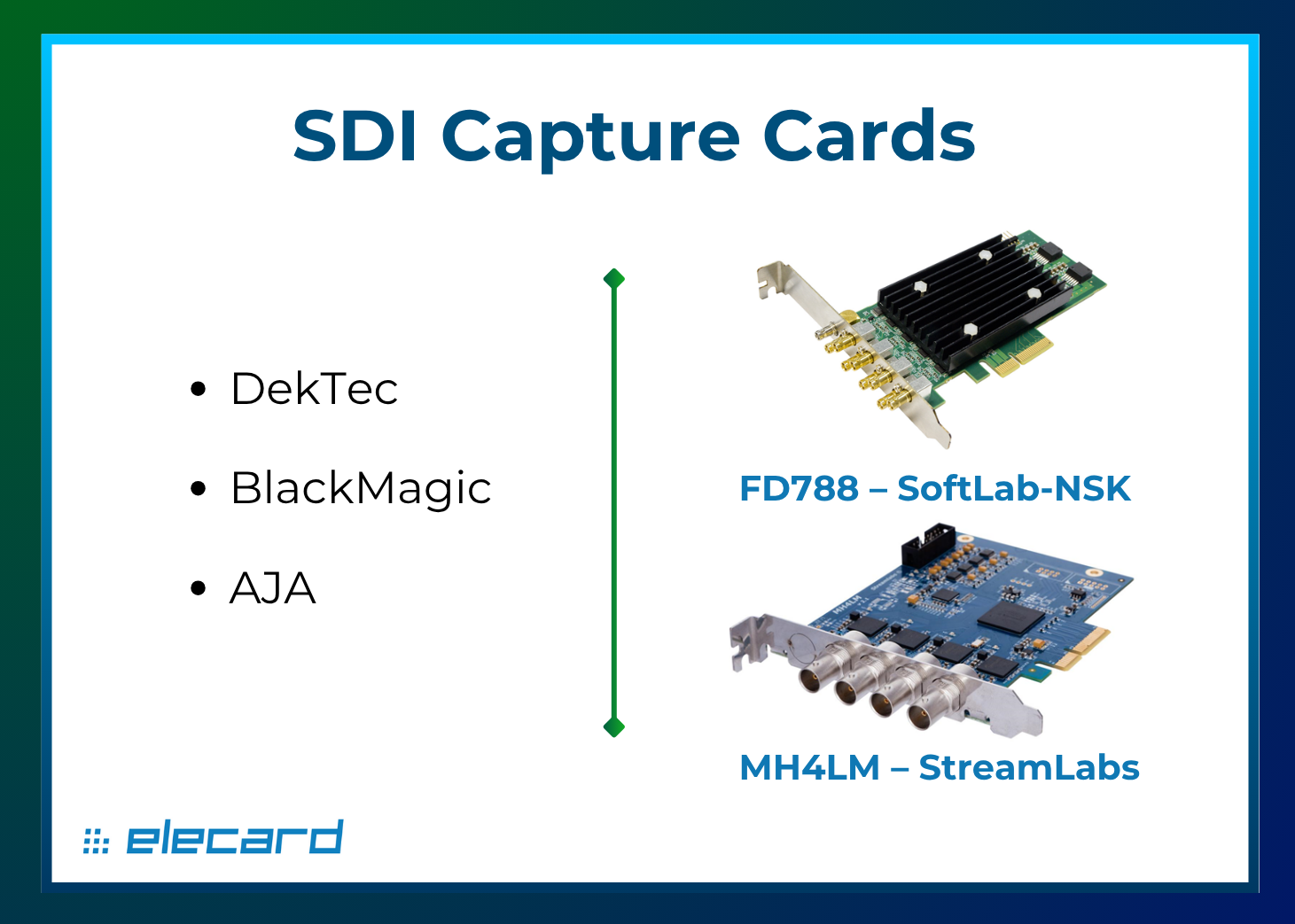
Examples of SDI capture card manufacturers include DekTec, Blackmagic and AJA.
Software
To compress SDI signals into AVC/H.264, HEVC/H.265, or MPEG-2, an encoder is required. We recommend Elecard CodecWorks as one of the most advanced solutions for video encoding and multiplexing. There are also comparable alternatives available.
How Much Does SDI Compression Cost?
The cost of SDI compression depends on the chosen compression method and hardware power. Compression can be performed using CPUs (central processing units) or GPUs (graphics processing units).
CPU Encoding
CPU-based encoding allows flexibility in platform selection. Depending on your needs, you can choose a platform with 4 cores or scale up to 128 cores, encoding 1 to 32 channels accordingly.
For example, encoding with an Intel Xeon Silver 4510 processor would cost approximately $9,000 for a Supermicro server with two processors, sufficient RAM, and other necessary components. Below is an approximate cost calculation for encoding 8 or 16 channels:
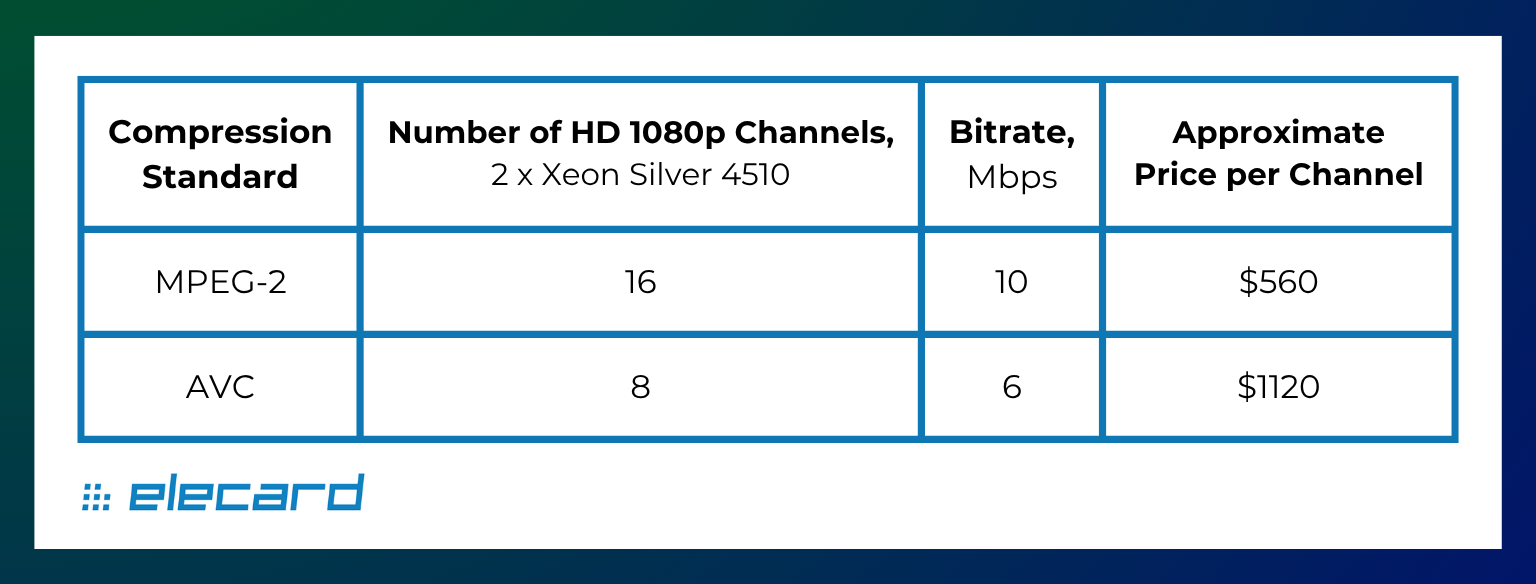
Estimated Hardware Costs for Encoding with Xeon Silver 4510
GPU Encoding
Using graphics cards significantly reduces encoding costs but comes with hardware limitations on encoding parameters (e.g., most Nvidia GPUs do not support interlaced encoding).
For instance, encoding with an Intel Arc A380 is very affordable in terms of both price and availability (this GPU can even be purchased in consumer electronics stores).
Although consumer-grade GPUs like the Intel Arc A380 are not professional solutions, they can serve as temporary or budget-friendly options in some cases.
Below is a comparison of popular AVC-based compression methods:
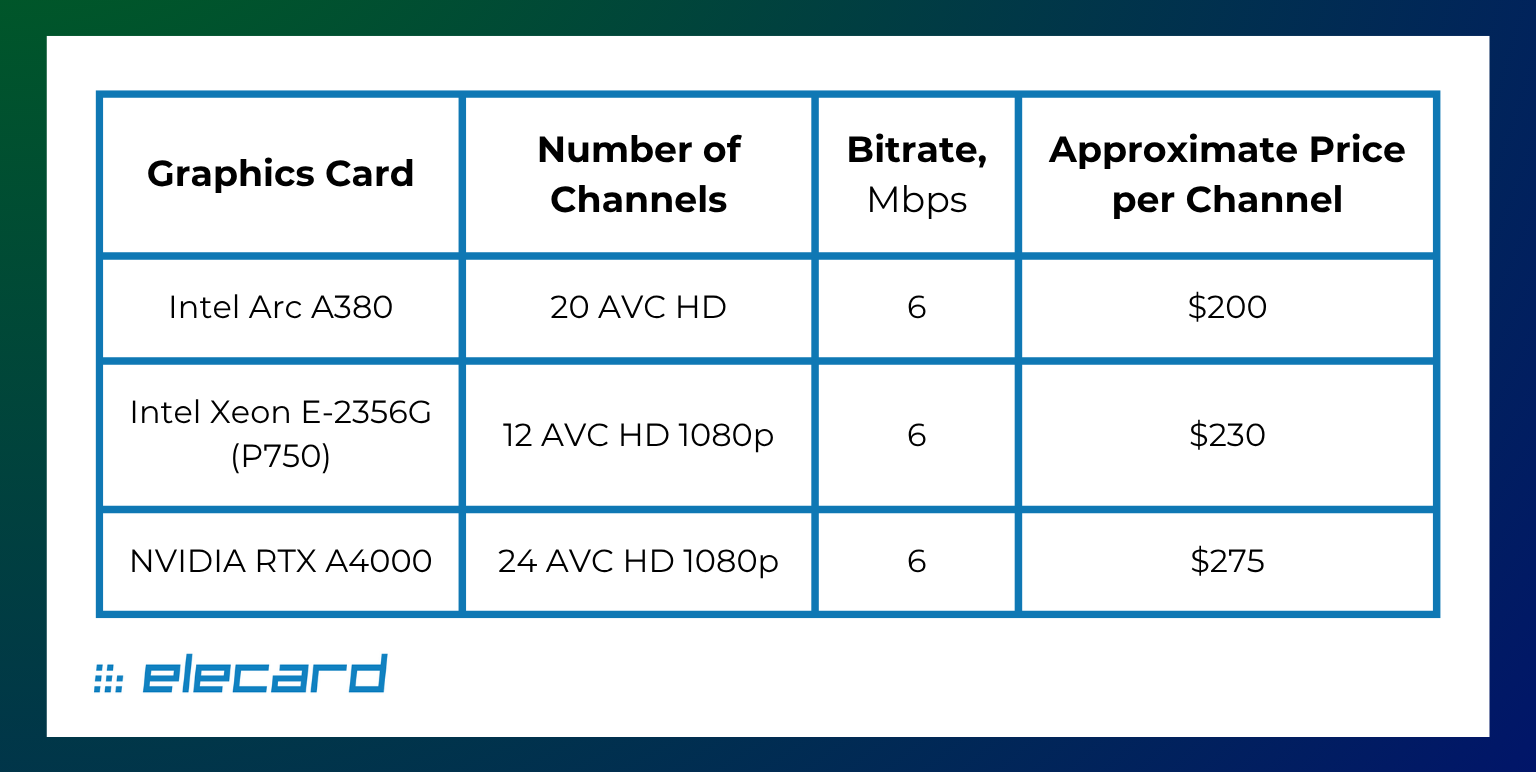
Estimated Hardware Costs for Encoding with GPUs
Conclusions
Compressing SDI signals is essential for more efficient content distribution. It enables video transmission over unlimited distances while significantly reducing bitrate. SDI encoding requires an SDI capture card, an encoding server, and an encoder.
GPU-based encoding is more cost-effective than CPU encoding, though it may have slightly lower stability.
Additionally, modern technologies allow full SDI signal transmission over IP using SMPTE 2110, reducing costs for inter-studio and production center connections. The latest release of Elecard CodecWorks includes SMPTE 2110 integration.
Learn more about SDI signal compression through our case studies:
- RTMP-Streaming to Youtube and Facebook
- Low Latency Encoding at Football World Cup 2018
Need help optimizing SDI transmission? Contact us for a consultation!
Email: sales@elecard.com

Author
Dmitriy Shmakov is a leading engineer at Elecard. He has been working in video analysis since 2021. Dmitriy is in charge of support of the Elecard's largest clients, such as Telstra, Globo, Amagi, Innet, etc.